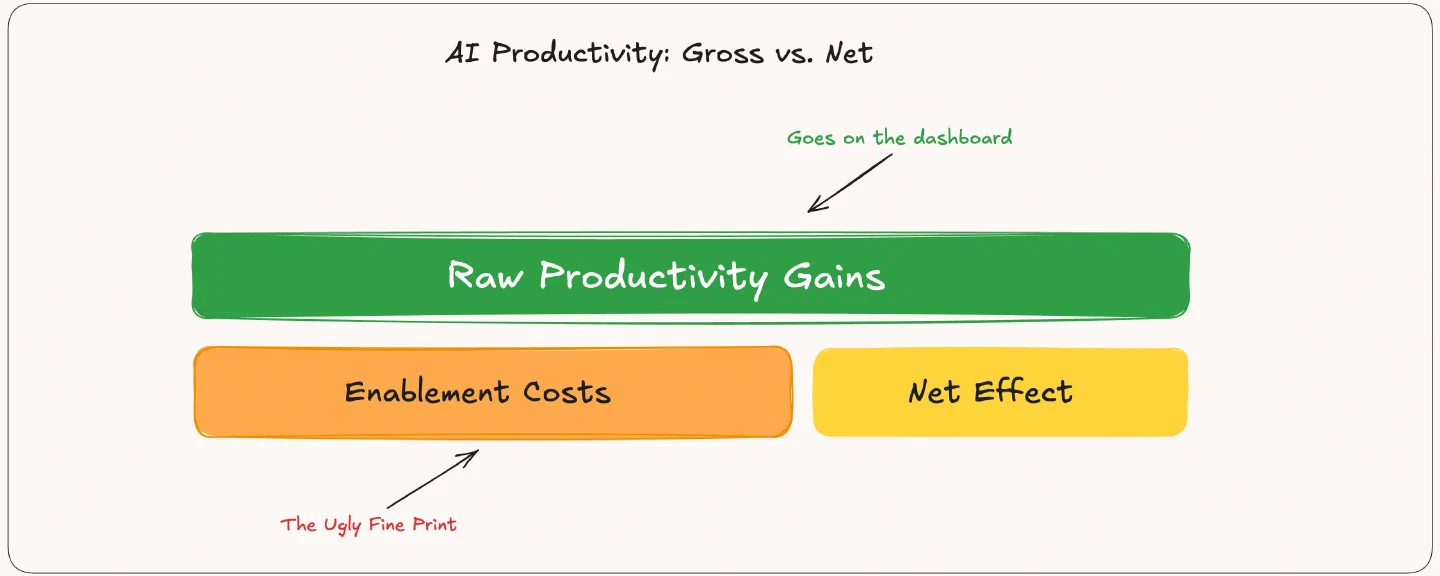
Enterprise AI has a productivity story that is being advertised quite a bit, but it also has a cost story. So far, discussions have been focusing only on the former.
I have been doing software consulting for 15+ years. There is always a workflow associated with it. The customer or the enterprise has a particular problem to solve, be it optimizing a business process or improving their product. The first question that comes back after proposing a solution: “How much is it going to cost?”
There is a lot of Q&A and assumption work before we come to an answer. That helps the customer figure out whether this is worth doing and whether the improvement will eventually justify this cost.
Fast forward to the current scenario of enterprise AI adoption - most of the executives are sold on the productivity gains from AI. They read several reports and came to a conclusion that they want AI in their enterprise for productivity gains, because the numbers look fascinating. In most cases, there definitely is productivity if you analyze the workflow correctly, if you see where AI fits and how it integrates, but the question is: “Have they asked themselves this question: ‘How much is it going to cost?’” Are we doing the economic analysis correctly in this? Let me break it down with some napkin math.
So let’s see what are the components involved. Let’s say in an eligible enterprise workflow there are certain parts that can be automated using AI, and other parts where human interaction is needed. And it is about making decisions based on AI where a human could become a bottleneck. For any workflow: in a non-AI scenario, it could be a human with some basic software doing things. In an AI-enabled scenario the bandwidth requirement of the human could be reduced and AI will make most of the decisions. That could bring a decent amount of productivity gains. For example, if the human was putting eight hours a day on that workflow, and now, with AI if he’s only spending two hours a day, you are literally getting a 75% productivity gain right there.
Here’s the enablement cost for that 75% gain:
- Engineering effort to build and integrate the AI agent
- Inference costs for every decision, retry, validation, and escalation
- A verification or governance layer
- Monitoring and evaluation infrastructure
- Human fallback for ambiguous or high-risk cases
- Ongoing maintenance as the workflow, data, and business rules change
All these things, whether it is software or inference cost or human as a fallback, all of this is additional cost for that productivity gain. If we incorporate these costs, that 75% raw productivity gain is now reduced to just 25% or 30%, which is still pretty meaningful by the way. So the raw productivity gain is not the same as the net productivity gain.
Maybe that’s why enterprises need to look beyond productivity gains. The additional effort around integration, governance, workflow redesign, and human oversight is often underestimated. When these costs are not accounted for, AI projects struggle to deliver returns that justify the investment.
Now would be a good time to ask these questions:
- Have you used inference efficiently if your engineers are wasting tokens on unnecessary testing or feature production or something which is not even needed for your agent?
- What’s the point if you are having ten agents talk to each other just for the sake of being AI-native?
- If you incentivize your employees for tokenmaxing, why would they think of saving on inference costs?
This could be one reason why many AI transformation programs disappoint. They measure AI usage, token consumption, or number of agents deployed, but they do not measure outcome efficiency.
At the end of the day, we need to look at outcome-oriented AI usage. If we introduce AI, how much productivity gains are we really getting after adding the ancillary costs? Without that analysis, AI productivity becomes a dashboard number with ugly fine print.
PS: This post was first published as an X article, here.