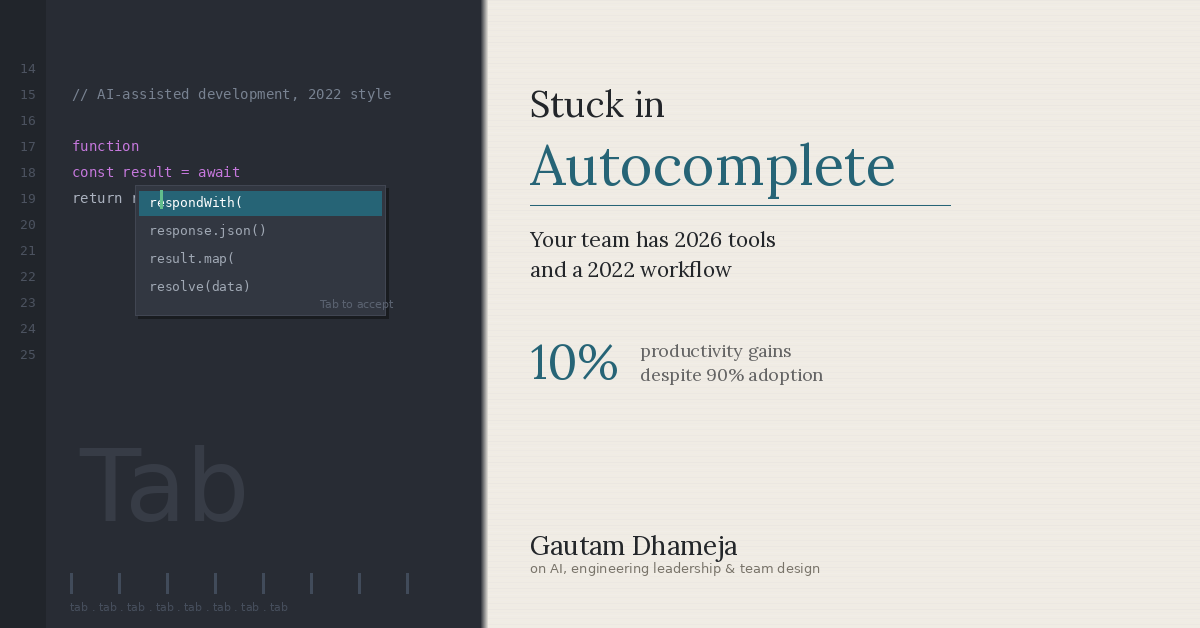
AI tools evolved from auto-complete in 2021 to chat in the editor in 2023 and full agentic coding in 2025, but the vast majority of developers are still stuck in phase one. The tools became more advanced. The usage did not.
AI tools are now capable of reading the entire codebases, planning multiple file changes, running tests and iterating autonomously. But the majority of developers are still using them the way they used Copilot in 2021: wait for a suggestion, hit tab, and move on.
Probably this is why the productivity gains and the effort savings from AI coding are still stuck at 10%. The same number in productivity savings despite the tools getting dramatically more powerful every quarter. I don’t think the explanation is that AI doesn’t work. We clearly see that it does. It’s that most people are not realizing what AI can actually do now.
The question is: is this a skill issue that the developers are not able to adapt to fully agentic coding, or is this a cautious choice because they want to understand the code that the AI is writing, or is it a mix of both?
It seems some of this is deliberate. Experienced developers want to understand what they are shipping. They don’t trust a black box agent making several changes they haven’t reviewed. There is also some distrust: one bad experience with an agent six months ago and the developer writes off the entire category.
On the other hand there is the harder truth: agentic coding demands a different skill. It requires you to think in terms of clear specifications, precise constraints, and system-level intent, before you ask AI to write a single line of code. That’s very different from what junior to mid-level engineers have been doing in their daily jobs. This is closer to what an architect and senior engineer does, but then the problem is these architects and senior engineers do not read or write code anymore. They are not able to validate the output AI is generating.
The stuck in auto-complete problem isn’t just about tool adoption. It’s about whether developers have been trained to work at the level of abstraction these tools require. If you are an engineering leader and your team is using 2026 tools with a 2022 mindset, the gap isn’t your tooling budget. It’s your enablement strategy.
Engineering managers and engineering leaders need to ask: are we teaching people how to use AI as a faster typewriter or as a collaborator that changes how the work gets scoped, delegated, and reviewed? The teams who will figure this out won’t be stuck at 10% productivity gains. They will restructure how engineering actually works.
References: Link to heading
- The DX report from early 2026 says the productivity gains have stayed at 10% only and this study covered 130k+ developers across 400+ companies.
- The Kilo team talks about building an AI assisted auto-complete. They argue that the auto-complete is the trust building on- ramp to agentic workflows and most developers are still in that phase.
- There is a slightly older study from Stack Overflow. It also suggests that people are still using autocomplete and not moving to fully agentic coding.
PS: This post was first published as an LinkedIn article here.